
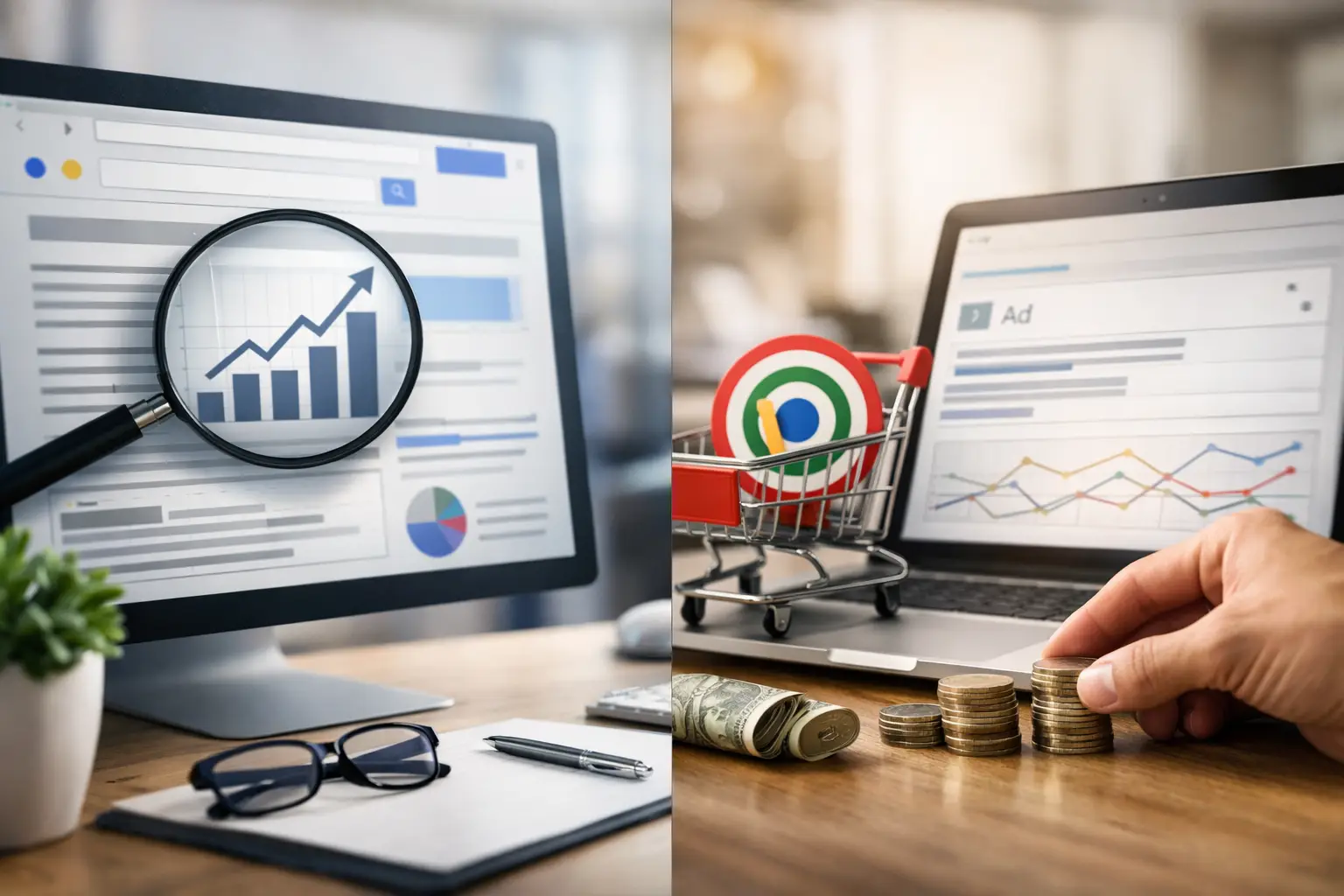
A business can spend months improving its website and see little movement, then launch a Google Ads campaign and receive enquiries that same week. That is why the SEO vs Google Ads question is not really about which channel is “better”. It is about what your business needs next, what it can afford to test, and what will still be working for you six or twelve months from now.
For most small and mid-sized businesses, the strongest answer is not an either-or decision. SEO and Google Ads solve different problems. One builds long-term visibility; the other buys immediate access to people already searching. The mistake is treating them as interchangeable, or expecting either one to fix a website that does not give visitors a clear reason to get in touch.
SEO vs Google Ads: the practical difference
SEO, or search engine optimisation, is the work of improving your website so it can appear prominently in unpaid Google results. That includes making pages technically sound, creating useful content, targeting relevant search terms, strengthening local visibility and ensuring your site answers what potential customers are actually looking for.
Google Ads places paid listings at or around the top of search results. You choose the searches you want to appear for, set a budget and pay when someone clicks your advert. With the right campaign setup, ads can put your business in front of high-intent prospects quickly.
The key difference is ownership. With SEO, you are building an asset on your own website. Rankings can fluctuate, but useful pages and a well-optimised site continue to create opportunities after the initial work is done. With Google Ads, visibility stops when the budget stops. You are renting attention, not building it.
That does not make paid advertising a poor choice. A rented shop unit can still be very profitable if it is in the right location and brings in the right customers. It simply means you need to understand what you are paying for and what happens if you pause spend.
When Google Ads makes more sense
Google Ads is often the right starting point when you need demand quickly. A new business, a company entering a new service area, or a firm with an immediate sales target can use ads to generate data and enquiries while longer-term SEO work gains traction.
It is particularly useful where the search intent is clear. Someone searching “emergency electrician near me”, “commercial insurance quote” or “accountant for limited company” may be ready to make contact now. A focused ad, a relevant landing page and a simple enquiry process can turn that intent into leads.
Ads also give you control. You can increase spend during a busy period, promote a specific service, pause campaigns when capacity is full, and see which search terms are producing calls or form submissions. That flexibility is valuable when managed properly.
The trade-off is cost and competition. In sectors such as legal services, home improvements, finance and professional services, a single click can be expensive. More importantly, a click is not a lead. If your advert sends people to a slow website, a vague service page or a form that feels like hard work, your budget can disappear without producing meaningful results.
Google Ads needs active management, not a one-time setup. Search terms need reviewing, irrelevant clicks need excluding, bids need adjusting and conversion tracking needs to be accurate. Without that, it is easy to mistake website visits for marketing success.
When SEO is the smarter investment
SEO is usually the better fit when you want a dependable stream of enquiries over time and your customers use search engines to research before choosing a supplier. It is especially valuable for businesses that serve a local area, offer several related services or want to reduce their reliance on paid lead sources.
A good SEO programme begins with the basics: a website that loads well, works properly on mobile, explains services clearly and gives Google enough context to understand each page. From there, local pages, service-led content, Google Business Profile improvements and credible authority signals can help you compete for relevant searches.
The biggest benefit is cumulative value. A well-written page about a service you provide can attract visitors month after month. The same work can support your sales team, answer common customer questions and make your business look more credible before someone ever picks up the phone.
The trade-off is patience. SEO rarely produces instant results, particularly on a new website or in a competitive market. Google needs time to crawl, understand and assess your pages. You may see early improvements within a few months, but meaningful growth often takes longer. Anyone promising a guaranteed number-one position by a certain date is selling certainty they do not have.
SEO also requires consistency. Publishing thin pages stuffed with keywords will not build sustainable visibility. Nor will copying the same service description across every town you want to target. Search engines and customers both respond better to pages with genuine value, clear expertise and useful local relevance.
Cost is not just the monthly budget
Business owners often compare SEO retainers with Google Ads spend and assume the lower figure is the cheaper option. That is not the full picture.
With Google Ads, there is ad spend plus campaign management, landing-page work and the cost of following up leads quickly. If your average customer is worth £2,000 and you acquire one profitable customer for every £500 spent, the campaign may be working very well. If enquiries are weak or nobody answers the phone, even a modest budget is wasted.
With SEO, the investment goes into strategy, technical fixes, content, optimisation and ongoing improvement. The return can grow over time, but it is harder to tie every future enquiry to one month’s work. A page improved today may become a lead source several months later.
The better question is not “Which is cheaper?” Ask: “What is a qualified lead worth to us, how many do we need, and how quickly do we need them?” That creates a sensible basis for deciding where to invest.
Why your website decides the outcome
Neither channel can compensate for a website that creates doubt. If visitors cannot quickly understand what you do, where you work, who you help and how to contact you, traffic will not turn into business.
Before increasing spend on SEO or ads, check the customer journey. Does each service have a dedicated page? Are your contact details obvious? Do testimonials, case studies or accreditations provide reassurance? Does the page work properly on a phone? Is the call to action clear without sounding pushy?
This is where many campaigns lose money. The marketing is blamed, but the real issue is the destination. Improving conversion rate means the same number of clicks or organic visitors can produce more enquiries, making every pound work harder.
A sensible way to use both
If budget allows, use Google Ads for immediate, high-intent demand while building SEO around the services and locations that matter most. Ads can also reveal which searches convert, giving you useful evidence for your SEO priorities. If people consistently enquire after searching for a particular service, that is a strong case for creating or improving an organic page around it.
Start narrow rather than trying to advertise every service and rank for every possible phrase. Choose the work that is most profitable, most in demand and most realistic for your business to deliver well. Track calls, forms and booked appointments, not just impressions and clicks.
For a tighter budget, choose based on urgency. If you need leads now and have a strong landing page, a carefully managed Google Ads campaign may be the practical first move. If you can invest steadily and want lower dependence on paid traffic in the future, prioritise SEO foundations. In either case, leave room to improve the website itself.
The right choice is the one you can measure
There is no prize for running the most complicated marketing plan. A small, well-tracked campaign that brings in profitable work is more useful than a large strategy full of reports and empty jargon.
At MAWEBDESIGN, we encourage businesses to look beyond clicks and rankings. The useful measures are qualified enquiries, conversion rates, cost per lead, booked work and revenue. Those figures tell you whether your marketing is helping the business grow, not simply making the dashboard look busy.
Start with the channel that matches your immediate need, keep the setup clear, and review the results honestly. As your website and data improve, you can make the next decision with evidence rather than guesswork.