
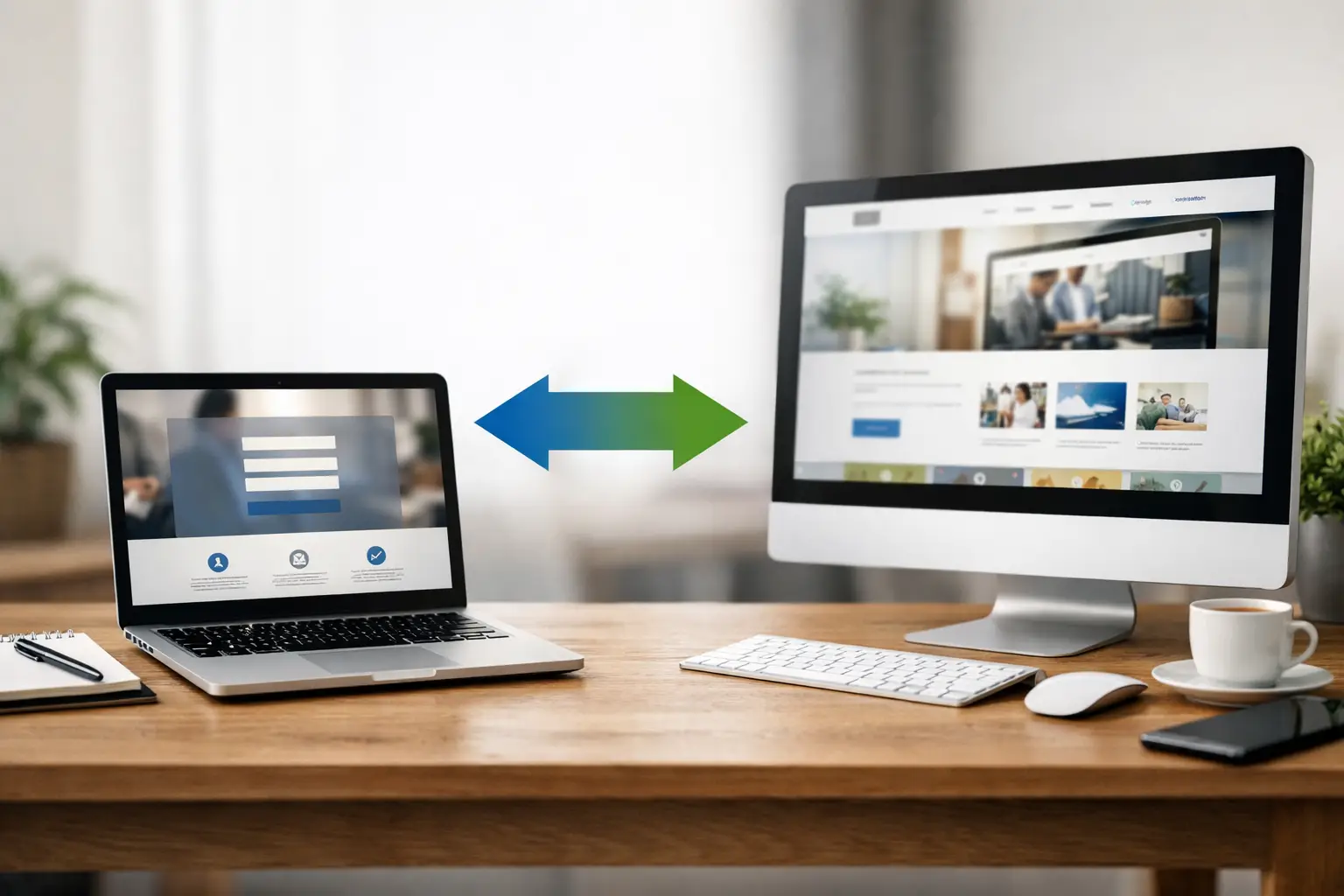
A paid advert can send 100 people to your business in a day. Whether they become enquiries or disappear after ten seconds often comes down to one decision: landing page vs website. They are not competing versions of the same thing. They do different jobs, and using the wrong one can make good marketing spend work far harder than it should.
For most small businesses, the right answer is not automatically one or the other. It depends on where visitors come from, what they need to know before contacting you, and the single action you want them to take.
Landing page vs website: the core difference
A website is your business’s digital home. It gives people room to look around, understand what you offer, check your credibility, compare services and decide whether you are the right fit. It usually includes pages such as Home, About, Services, Case Studies, Reviews, Blog and Contact.
A landing page is a focused page built for one campaign, audience or offer. Its purpose is to move a visitor towards one clear action: request a quote, book a call, download a guide, register for an event or buy a product.
The simplest way to think about it is this: a website helps people research your business; a landing page helps people respond to a specific message. A good website may contain several landing pages, but not every webpage is a true landing page.
That focus matters. When someone clicks a Google Ad for “emergency boiler repair in Leeds”, they do not need a tour of every service your company offers. They need immediate reassurance that you cover their area, can help quickly, are qualified and can be contacted without fuss.
What a website is built to do
A proper business website supports the bigger picture. It establishes trust over time and gives search engines enough useful, well-organised content to understand what you do and where you work.
For a service business, that often means dedicated pages for each main service, clear information about your process, real testimonials, examples of work and straightforward ways to get in touch. It should answer the questions a potential customer is likely to have before they pick up the phone.
Websites support organic visibility
If you want to appear in Google searches for a range of services, locations and customer questions, you need more than one campaign page. Search engine optimisation works best when your website has relevant pages that genuinely help visitors.
For example, an accountant may need pages for tax returns, bookkeeping, payroll and business advisory services. A single landing page cannot realistically do all of that without becoming confusing and thin. Your website provides the structure for long-term visibility.
Websites build confidence for considered purchases
The more expensive, technical or personal the purchase, the more likely people are to research before enquiring. A homeowner choosing a building firm, or a director selecting an IT provider, may visit several pages before making contact.
In these cases, a website gives visitors the proof they need. They can see who is behind the business, how you work, what previous clients say and whether your offer feels credible. A landing page can introduce the conversation, but the wider website often helps close it.
What a landing page is built to do
Landing pages reduce distractions. They remove unnecessary navigation, competing calls to action and broad company information so the visitor can make one decision.
That does not mean a landing page should be bare or pushy. It still needs enough detail to earn trust. The difference is that every section should support the same conversion goal.
A strong landing page commonly includes a clear headline, a specific benefit, proof points, a concise explanation of the offer, testimonials or results, and a form or contact button. The page should make it obvious what happens after someone gets in touch.
Landing pages make paid campaigns easier to measure
If you run Google Ads, social advertising, email campaigns or a time-limited promotion, a dedicated landing page gives you a cleaner view of performance. You can see how many people arrived, completed the form, called the business or booked a consultation.
Sending paid traffic to a general homepage can work, but it often creates too many choices. A visitor who clicked an advert for a free website audit may land on your homepage, browse your services, read an article and leave. You have paid for the click without giving them a direct next step.
A campaign-specific page keeps the advert and destination aligned. If the advert promises a fixed-price loft conversion quote, the page should immediately continue that conversation. No jargon, no hunting through menus and no uncertainty about what to do next.
Landing pages work best with a narrow offer
The more precise the message, the more useful a landing page becomes. Good examples include a seasonal offer, a local service, a free consultation, a product launch or a campaign aimed at one type of customer.
A dental practice might use a landing page for Invisalign consultations. A recruitment agency might build one for employers hiring warehouse staff. A B2B consultant could use one for a downloadable guide that starts an email follow-up sequence.
The key is relevance. Trying to put every service, audience and message on one landing page usually recreates the same confusion as an unfocused homepage.
When a website is the better investment
If your business has little or no credible online presence, start with the website. Paid campaigns can generate attention quickly, but they cannot replace the trust and discoverability a well-planned site creates.
A website should usually come first when you need to:
- Explain several services or serve different customer groups
- Build visibility through SEO over the long term
- Show projects, reviews, team information or accreditations
- Give referrals somewhere credible to check you out
- Create a foundation for future advertising and content
This is especially true for businesses where customers compare providers carefully. A thin one-page site may be cheaper initially, but it can limit your marketing later. You may end up rebuilding it once you want to target new locations, add services or run more focused campaigns.
When a landing page is the better choice
Choose a landing page when you already have a clear offer and a reliable source of targeted traffic. It is a practical tool for turning attention into action, not a substitute for a broader online presence.
It is often the right choice if you are launching a paid campaign, promoting one high-value service, testing a new offer or collecting leads before an event. It can also be useful for businesses with established websites that want a more focused destination for a particular advert.
There are trade-offs. A landing page may convert well for one campaign but do very little for your wider search visibility. It also needs ongoing attention. If the offer changes, the form does not work or the page loads slowly on mobile, performance drops quickly.
How to decide without overcomplicating it
Start with the visitor’s intent. Ask what they searched for, clicked on or were told about before reaching your page. Then ask what one action would count as a successful outcome.
If they are still getting to know your business, give them a website that makes research easy. If they have responded to a specific offer and are close to taking action, send them to a focused landing page.
The strongest setup for many businesses is both: a well-built website that establishes your brand, services and credibility, plus dedicated landing pages for advertising campaigns and priority offers. Your website provides the foundation. Your landing pages provide the focused routes into it.
Conversion is not just about the page
It is tempting to blame a page when leads are low, but conversion depends on the full journey. The advert or search result needs to attract the right people. The page needs to match their expectations. The form needs to be simple, and your team needs to respond promptly once an enquiry arrives.
A landing page with a vague advert will not fix poor targeting. Equally, a brilliant website will not make up for an offer nobody wants. Look at the whole chain before changing designs or increasing ad spend.
Small details have an outsized effect: mobile speed, clear phone numbers, honest pricing guidance where appropriate, relevant testimonials and forms that ask only for information you will actually use. These are not flashy changes, but they remove reasons for people to hesitate.
The useful question is not whether a landing page or website is universally better. It is whether your next visitor has a clear reason to trust you and a simple way to take the next step. Build around that, measure what happens, and improve the parts that are holding enquiries back.