
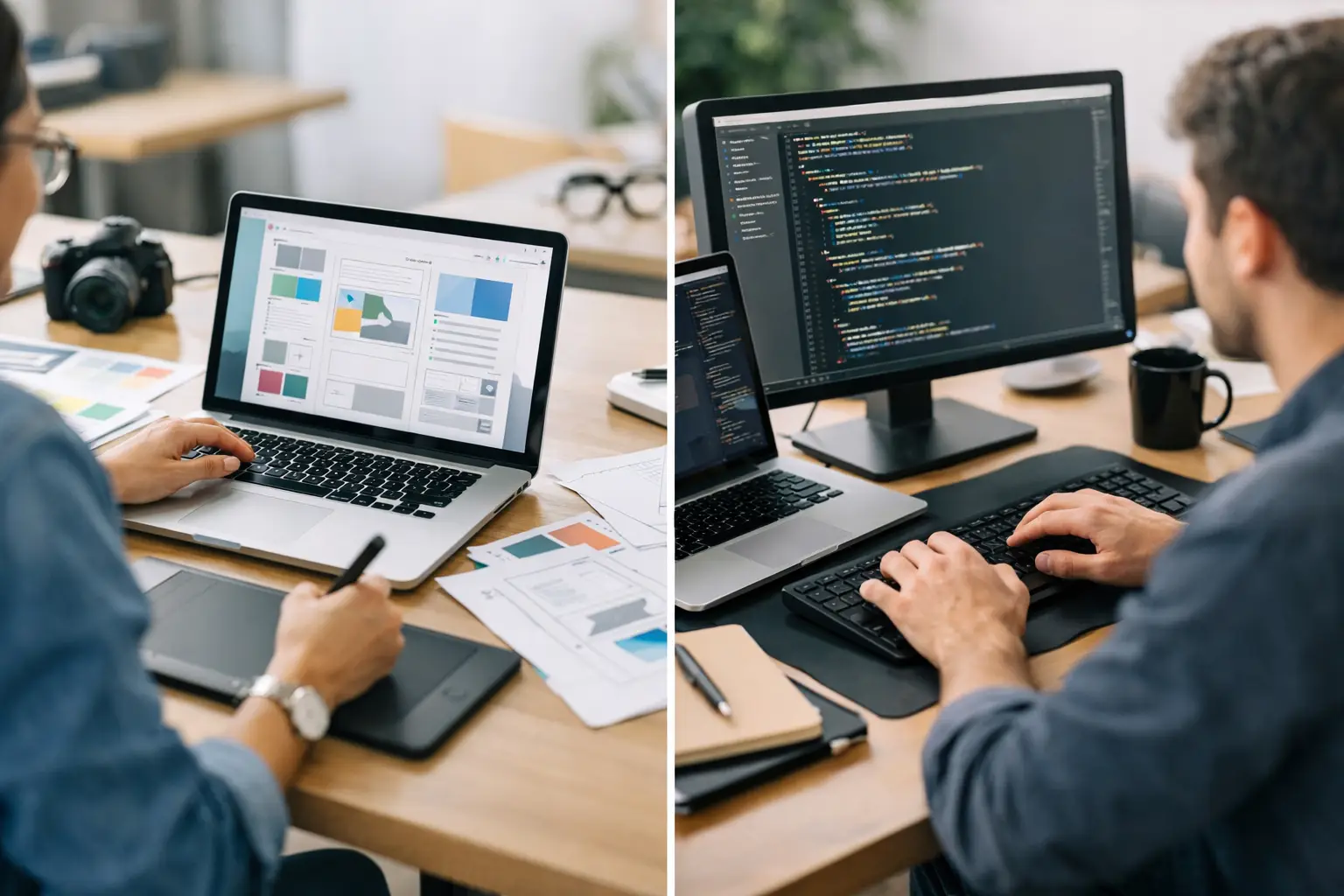
If you’ve ever asked for a new website and been met with terms like UX, front-end, back-end, wireframes and CMS setup, you’re not alone. For most business owners, the difference between web design and development only becomes relevant when a project starts going wrong, costs start climbing, or the finished site looks good but fails to bring in enquiries.
The short version is simple. Web design focuses on how a website looks, feels and guides people. Web development focuses on how it works. One shapes the experience your visitors have. The other builds the systems that make that experience possible.
That sounds straightforward, but in real projects the two overlap constantly. If you are hiring for a new site, redesigning an old one or trying to work out why your current website is underperforming, understanding where design ends and development begins can save you time, money and a lot of confusion.
What is the difference between web design and development?
Web design is about presentation, usability and communication. It covers layout, colour, typography, imagery, page structure and the overall journey a visitor takes through the site. A good designer thinks about first impressions, trust, clarity and conversion. They are not just making something look attractive. They are deciding how information is prioritised and how people move from landing on a page to taking action.
Web development is the technical build behind that experience. It turns designs into a working website using code, platforms and integrations. Development covers everything from responsive layouts and page speed to contact forms, booking systems, database connections and content management setup. If design is the blueprint, development is the construction.
A simple way to think about it is this: design decides where the door goes and how inviting the entrance feels. Development makes sure the door opens, locks properly and does not fall off its hinges.
Why businesses often confuse the two
A lot of agencies and freelancers bundle both services together under the label of web design. That is not necessarily wrong, but it can hide who is actually doing what. If someone says they build websites, that might mean they handle strategy, design and development themselves. It might also mean they design in a mock-up tool and pass the build to somebody else.
For a business owner, the confusion usually comes from the fact that both disciplines affect the final result. If a page is slow, visitors blame the website as a whole. If the design is cluttered, they do the same. They do not separate the visual and technical sides, and frankly they should not have to. But when you are planning a project, that distinction matters.
It matters for budget, timelines, scope and expectations. You might think you are paying for a visual refresh when what you actually need is a structural rebuild. Or you might assume a developer will improve conversion rates when the real issue is poor messaging and weak page design.
What web design actually includes
Good web design starts before anyone picks a font or chooses a colour palette. It begins with understanding the business, the audience and the goal of the site. For a local service business, that might mean making contact details obvious and building trust quickly. For an e-commerce business, it might mean reducing friction between product discovery and checkout.
Design work usually includes page layouts, navigation structure, mobile responsiveness from a visual point of view, button placement, brand consistency and content hierarchy. It often also involves wireframes or mock-ups that show how pages will look before the site is built.
The best design decisions are rarely the flashiest ones. They are the ones that make a website easier to use. Clear headings, sensible spacing, readable text and obvious calls to action are design choices. So is deciding what not to include. A site packed with animation, oversized banners and competing messages may look expensive, but it often performs badly.
This is where design directly affects business results. Visitors make quick decisions. If your site feels dated, confusing or hard to use, trust drops. If it feels clear and credible, people stay longer and are more likely to enquire.
What web development actually includes
Development takes the approved design and turns it into a functioning website. That can mean building with a platform such as WordPress, using a custom framework, or working within an e-commerce system. The exact tools matter less than the outcome: the website must work reliably, load properly and support the actions your business needs visitors to take.
Development includes front-end work, which is what users interact with in the browser, and back-end work, which handles the underlying functionality. Front-end development makes sure the design displays correctly across desktop, tablet and mobile. Back-end development deals with systems such as databases, user logins, form handling, integrations and dynamic content.
A developer also needs to think about performance, security and maintenance. A beautiful site that breaks on mobile, loads slowly or is difficult to update becomes a business problem very quickly.
This is why development is not just about writing code. It is about building something stable enough to support marketing, content updates, SEO work and future growth.
The overlap matters more than the labels
The difference between web design and development is useful to understand, but it should not turn into a turf war. In strong website projects, design and development inform each other from the start.
For example, a designer might create a layout that looks excellent in a static mock-up, but if it relies on heavy animations or awkward mobile behaviour, the build may become slow or expensive. On the other side, a developer might build a site that is technically sound, but if the structure is clumsy and the content is hard to scan, performance will still suffer.
The best results come when both sides work with the same goal in mind: a website that looks professional, works properly and helps the business grow.
Which one does your business need?
It depends on the problem you are trying to solve.
If your website works fine technically but looks outdated, confuses users or does not reflect your brand properly, the main issue may be design. If your site looks decent enough but is slow, broken, difficult to edit or missing key features, development is probably the bigger priority.
Often, though, businesses need both. A redesign without proper development can lead to a polished-looking site with weak foundations. A rebuild without proper design can produce a technically improved site that still does not convert.
This is especially true if your website plays a role in lead generation. Design influences whether people trust you. Development influences whether the site performs well enough to support search visibility, usability and enquiries. One gets people interested. The other makes sure nothing gets in their way.
A common mistake: treating design as decoration
One of the biggest misconceptions is that design is the cosmetic part and development is the serious part. That is a costly way to think about it.
Design is not decoration. It is commercial decision-making. The order of information on your homepage, the wording on your buttons, the visibility of your contact options and the layout of your service pages all shape whether visitors act or leave.
Likewise, development is not just background technical work. It affects search performance, mobile usability, accessibility and site reliability. If your forms do not work consistently or your pages take too long to load, you lose leads whether the design is strong or not.
What to ask before hiring anyone
If you are speaking to a web partner, ask who is handling design and who is handling development. Ask whether they are creating a custom design or adapting a template. Ask how the site will perform on mobile, how easy it will be to update, and what happens after launch if something needs fixing.
You do not need to become technical. You just need clear answers in plain English. A good agency or freelancer should be able to explain the difference without hiding behind jargon. That matters because websites are not art projects or code exercises. They are business tools.
For many small and mid-sized companies, working with a team that can manage both sides is often simpler. It reduces handover issues, avoids mixed messages and keeps accountability in one place. That is one reason businesses choose partners like MAWEBDESIGN – not for buzzwords, but for clarity, joined-up execution and a site that actually supports growth.
The real question is not design or development
The real question is whether your website is doing its job.
A good website should make your business look credible, help the right people find what they need quickly and turn interest into action. That takes thoughtful design and solid development working together, not in separate silos.
If you are weighing up a new website project, do not get too hung up on the label. Focus on the outcome. Ask what needs improving, what is stopping the site from performing now, and what will make it easier for your customers to trust you and get in touch. When those answers are clear, the split between design and development becomes much easier to navigate.