

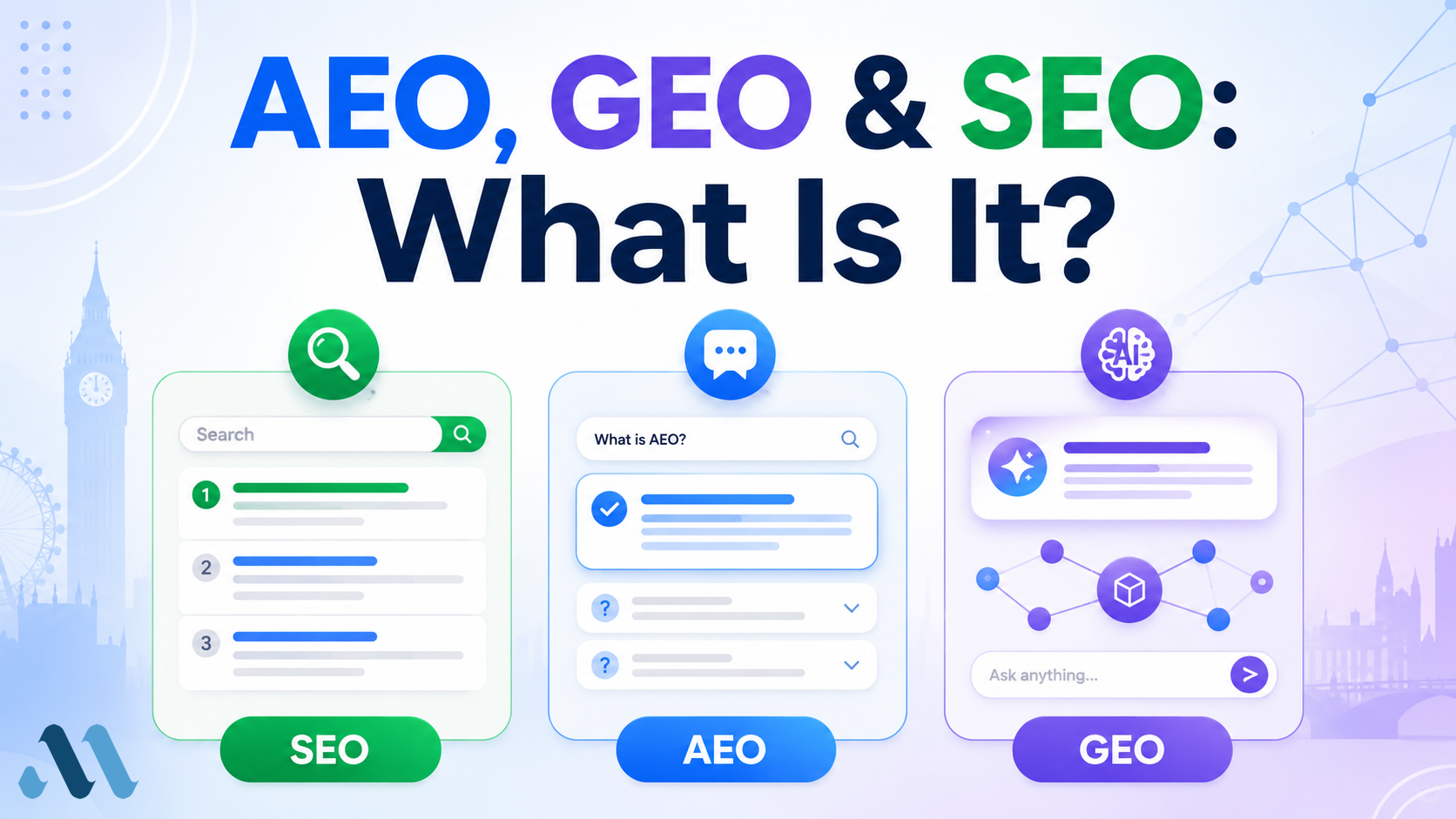
This means businesses now need to understand not only SEO, but also AEO and GEO.
At Mawebdesign, we help UK businesses improve their online visibility by making websites clearer, more useful and easier to find. In this guide, we’ll explain what AEO, GEO and SEO mean, how they differ, and why they all matter.
SEO stands for Search Engine Optimisation. It is the process of improving your website so it can appear higher in search engine results, such as Google or Bing.
When someone searches for a product, service or question related to your business, SEO helps your website become more visible. For example, a UK business may want to appear when someone searches for “web design services near me” or “SEO support for small businesses”.
SEO usually includes:
Good SEO helps your website attract more organic traffic. This means visitors can find you without you paying for every click.
Even with the rise of AI search, SEO remains important. Search engines still need to understand your website, your services and your location. If your website is slow, confusing or missing key information, it may struggle to rank well.
For UK businesses, SEO can help attract local customers, build brand awareness and generate enquiries. It also supports your wider digital marketing strategy because many AEO and GEO improvements are built on strong SEO foundations.
AEO stands for Answer Engine Optimisation. It focuses on making your content easy for answer engines to understand and use.
An answer engine is designed to give users a direct answer, rather than simply showing a list of links. Examples include voice assistants, featured snippets, “People Also Ask” results and AI-style answer boxes.
AEO is about answering questions clearly and directly. For example, instead of writing only a general page about SEO, a business might include a clear section that answers: “What is SEO?” or “How does SEO help small businesses?”
AEO usually includes:
The goal is to make your content more likely to appear when someone asks a specific question.
People now search in more conversational ways. Instead of typing “SEO UK”, they may ask, “What is the difference between SEO and AEO?” or “How can I make my website appear in AI answers?”
AEO helps your business become part of those direct answers. This can improve visibility even when users do not click through immediately. It also positions your brand as helpful and trustworthy.
For service-based businesses, this matters because customers often begin their journey by asking questions. If your website provides the clearest answer, you have a better chance of being noticed.
GEO stands for Generative Engine Optimisation. It is the process of optimising your content so it can be understood, referenced or surfaced by AI-powered platforms and generative search tools.
Generative engines use artificial intelligence to create answers. Instead of only listing websites, they may summarise information from several sources. This means your content needs to be clear, accurate and well-structured so AI systems can understand what your business offers.
GEO can include:
GEO is especially important as more users rely on AI tools to research companies, compare services and make decisions.
AI-powered search is becoming a bigger part of how people find information online. A potential customer may ask an AI tool for help choosing a web design company, understanding digital marketing or comparing SEO services.
If your website content is vague or thin, AI systems may not understand your relevance. But if your content is clear, useful and trustworthy, your business has a better chance of being included in AI-generated responses.
For UK businesses, GEO can support brand visibility beyond traditional search results. It helps make sure your expertise is easier to discover across newer platforms.
Although AEO, GEO, and SEO are connected, each has a different focus.
SEO helps your website rank in traditional search engine results. It focuses on keywords, technical performance, content quality and authority.
AEO helps your content answer specific questions clearly. It focuses on direct answers, FAQ-style content and visibility in answer-based search features.
GEO helps your content become easier for AI-powered platforms to understand and reference. It focuses on clarity, trust, structure and usefulness for generative search.
In simple terms:
SEO helps people find your website. AEO helps people find their answers. GEO helps AI platforms understand and surface your expertise.
The best results often come from using all three together. SEO builds the foundation. AEO improves your ability to answer questions. GEO prepares your content for the future of AI-powered discovery.
For example, a well-optimised service page should include relevant keywords, clear headings, helpful explanations, FAQs, accurate business details and trustworthy content. This makes it easier for search engines, answer engines and AI tools to understand your business.
At Mawebdesign, we help businesses create websites and content that are built for modern search. Whether you want to improve your SEO, create clearer answer-led content or prepare your website for AI-powered platforms, we can help.
We focus on practical, beginner-friendly strategies that make your website easier to find and easier to understand.
To discuss AEO, GEO and SEO for your business, contact Mawebdesign today on 01952 370 058.